
 HOME
HOME
Installation Precautions 2
Setting-up a Safety Fence
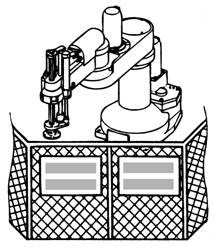
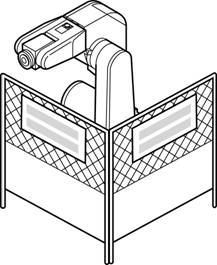
A safety fence should be set up so that neither operator nor third person can easily enter the robot's restricted space. Safety fences should be set up based on user's risk assessment.
Example
- The fence should be constructed so that it cannot be easily moved or removed.
- The fence should be constructed so that it cannot be easily damaged or deformed through external force.
- Establish the exit/entrance to the fence. Construct the fence so that neither operator nor third person can easily get past it by climbing over the fence.
- The fence should be constructed to ensure that it is not possible for hands or any other parts of the body to get through it.
- Take any one of the following protections for the entrance/ exit of the fence:
- Place a door, rope or chain across the entrance/exit of the fence, and fit it with an interlock that ensures the emergency stop device operates automatically if it is opened or removed.
- Post a warning notice at the entrance/exit of the fence stating "In operation--Entry forbidden" or "Work in progress--Do not operate" and ensure that workers follow these instructions at all times.
- When making a test run, before setting up the fence, place an overseer in a position outside the robot’s restricted space and one in which he/she can see all of the robot’s movements. The overseer should prevent workers from entering the robot's restricted space and be devoted solely to that task.
Setting the Robot's Motion Space
The area required for the robot to work is called the robot's operating space.
If the robot’s motion space is greater than the operating space, it is recommended that you set a smaller motion space to prevent the robot from interfering or disrupting other equipment.
No Robot Modification Allowed
Never modify the robot unit, robot controller, teach pendant or other devices.
Cleaning of Tools
If your robot uses welding guns, paint spray nozzles, or other end-effectors requiring cleaning, it is recommended that the cleaning process be carried out automatically.
Lighting
Sufficient illumination should be assured for safe robot operation.
Protection from Objects Thrown by the End-effector
If there is any risk of workers being injured in the event that the object being held by the end-effector is dropped or thrown by the end-effector, consider the size, weight, temperature and chemical nature of the object and take appropriate safeguards to ensure safety.
Affixing the Warning Label
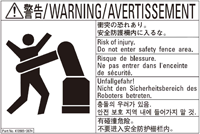
Place the warning label pack¬aged with the robot on the exit/entrance of the safety fence or in a position where it is easy to see.
Posting the Moving Directions of All Axes
Post a notice showing axes names and moving directions in a visible location on the robot unit. The posted moving directions should match the actual directions. No posting or wrong direction posting may result in bodily injuries or property damages due to incorrect operation.
Changing the Configuration
When the components of the robot system or optional devices (including hardware software) have been changed or added, carry out necessary tests or inspections of safety functions.